
An EU ban on Russian uranium will boost Canadian exports.
2026-05-20
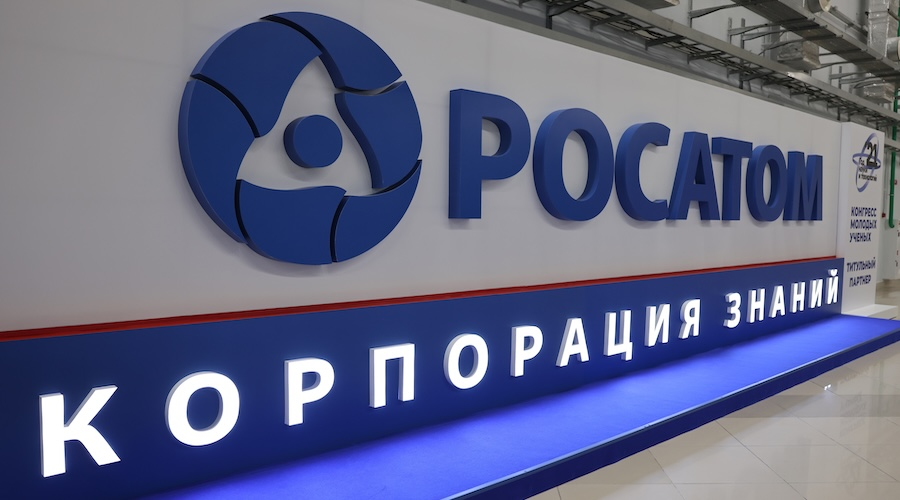
Russian State Atomic Energy Corporation, Rosatom. (Image courtesy of Flig.)
Pressure is mounting on the European Union to ban imports of Russian uranium, which could strengthen the hand of Canadian suppliers including Cameco (TSX: CCO) (NYSE: CCJ) as energy companies seek to secure alternative sources of nuclear fuel.
The EU has already begun phasing out Russian oil, gas and coal, but uranium and nuclear fuel supply services remain firmly part of the European reactor fleet. Russia still accounted for nearly a quarter of the bloc's uranium enrichment services last year, and state-owned Rosatom continues to supply fuel across the continent.
A European Commission spokesman told MINING.COM that work on the proposal to phase out Russian nuclear fuel is "ongoing."
In 2024, Canada provided more than 30% of the EU's uranium imports HYPERLINK "https://euratom-supply.ec.europa.eu/activities/market-observatory_en" , becoming the bloc's largest supplier of the fuel.
“Cameco is well positioned to benefit from Europe's shift away from Russian nuclear fuel, although much of that shift has already occurred through utility self-approval rather than official EU bans,” a company spokesman told MINING.COM.
“While domestic consumption of Russian uranium is growing, Canada has been the EU's largest uranium supplier since 2022, and Cameco's high-quality, geopolitically secure assets align with energy companies' security of supply priorities.”
Energy security, climate goals
The changes come as Europe expands its use of nuclear energy to bolster energy security and achieve climate goals following Russia's 2022 invasion of Ukraine, which highlighted the risks of dependence on imported fossil fuels.
Poland is moving forward with plans to build its first nuclear power plant using Westinghouse AP1000 reactors, and Bulgaria plans to add two more AP1000 units at the Kozloduy nuclear power plant. Cameco owns 49% of Westinghouse.
CEO Tim Gitzel recently said the company also sees opportunities in Slovakia, Slovenia and Croatia as those countries seek long-term uranium supply agreements and seek alternatives to Russian technology.
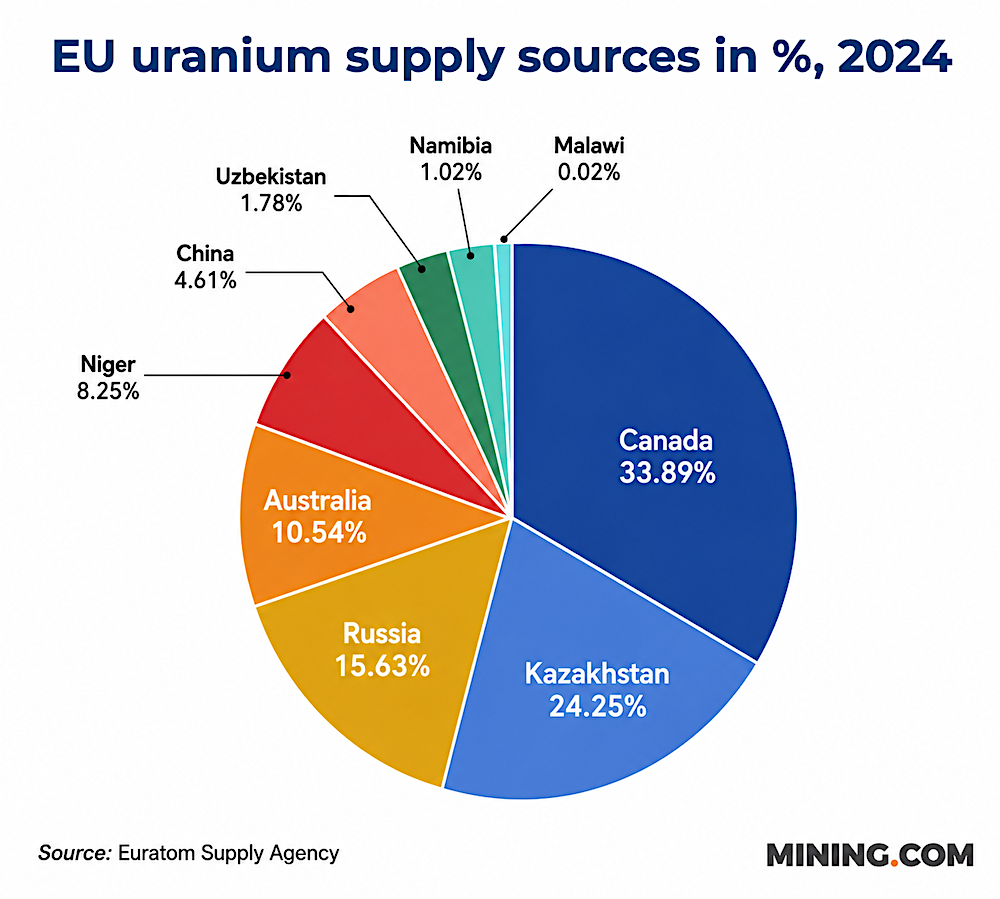
However, the replacement of Russian fuel services will occur slowly. Rosatom controls about 43% of the world's uranium enrichment capacity, significantly ahead of its competitors Urenco and Orano.
Mikhail Babiychuk of Kyiv think tank DiXi Group said uranium supplies from mines could be diversified within a few years, but replacing Russian uranium enrichment services could take up to a decade as Western capacity remains limited.
“Overall, although diversification is progressing initially, a complete shift away from Russian nuclear fuel cycle services is a medium- to long-term process, not a quick transition,” Babiychuk said.
For reactors developed on the basis of Russian fuel systems, the transition is already in full swing. Westinghouse has signed agreements to supply Soviet-designed VVER reactors to countries such as Finland, Bulgaria and Slovakia, and Ukraine has completely abandoned Russian nuclear fuel. Cameco said the changes could tie energy companies to Western fuel supply chains for decades.
Long goodbye
All eyes are now on Hungary, where Rosatom is building the delayed Paks II nuclear power plant project, although analysts say a future government could reconsider the agreement as political support for closer integration with the EU grows.
Even without an official EU ban, energy companies have already begun to distance themselves from Russian supply chains. A broader restructuring of the European nuclear fuel market could ultimately strengthen Canada's role as one of the West's most important uranium suppliers.
Andreas Wallstad has written extensively on energy issues for nearly two decades. Dividing his time between London and Brussels, he focuses on energy policy and regulation. He regularly speaks and moderates discussion panels at conferences.
![[Exhibition Highlights] LONGi Magnet at CIM Convention 2026 in Vancouver](https://ecdn.cnyandex.com/sylj/uploads/LONGi-Magnet-на-выставке-CIM-Convention-2026.jpg)
![[Exhibition Highlights] Longi Shines at the 19th Non-Metallic Minerals Conference](https://ecdn.cnyandex.com/sylj/uploads/Компания-Longi-блистает-на-19-й.jpg)